
A weekend in Lisbon, and what fits together
Friday to Sunday in Lisbon, planned by neighbourhood so you climb each hill only once: Baixa and Chiado, Alfama and Graça, then Belém and the river.
Lisbon is known as the city of seven hills, and the quickest way to tire of a weekend here is to cross them twice. Group your days by neighbourhood instead, and the city unfolds in a natural order: the grand riverside squares of the Baixa and the cafés of Chiado, the lanes and lookouts of Alfama and Graça, then the monuments of Belém on the broad estuary of the Tagus.
A city best taken one hill at a time
The heart of Lisbon sits in a valley between two hills. The Baixa, rebuilt on a strict grid in the second half of the eighteenth century, fills the flat ground between the river and the Rossio. To the west rise Chiado and Bairro Alto; to the east, the castle hill, with Alfama on its slopes and Graça above. Belém lies a few kilometres downriver, an easy ride by tram or by the suburban train from Cais do Sodré.
Planning your days this way saves your legs and lets each district be enjoyed at its own pace. The pavements are made of , small limestone and basalt cubes laid by hand in patterns, often polished smooth by countless footsteps, so comfortable shoes with a good grip are the most useful thing you can pack.
Arriving, getting around and where to stay
The metro links the airport with the city centre, and a reloadable navegante occasional card, still widely known by its former name Viva Viagem, works on the metro, buses, trams and the river ferries. Buy it from a machine at any metro station and load it with credit, a system known as zapping, so one card covers every ride of the weekend.
For a short stay, the Baixa and Chiado make the most practical base: level streets, good connections and both the river and the hills within easy reach. Alfama suits travellers who love quiet lanes and village atmosphere and do not mind a few steps at the end of the day. Príncipe Real, above Bairro Alto, is leafier and calmer, with gardens and grand old townhouses.
Three days, hour by hour
Friday Baixa, Chiado and a sunset view
- Morning
Praça do Comércio and Rua Augusta
Begin by the river at the Praça do Comércio, a vast arcaded square that opens straight onto the Tagus. Walk through the triumphal arch of Rua Augusta and up the pedestrian street into the Baixa’s grid of shops and cafés, as far as the Rossio and its wave patterned paving.
- Afternoon
Santa Justa lift and Chiado
Ride the Santa Justa lift, an iron tower that opened in 1902, or simply walk up the stepped lanes to Chiado. Here the city turns literary and elegant, with old bookshops, theatres and grand cafés around the Largo do Chiado. Nearby, the roofless Gothic arches of the Carmo convent frame the sky.
- Evening
Miradouro de São Pedro de Alcântara and Bairro Alto
Climb to the Miradouro de São Pedro de Alcântara for sunset, when the castle across the valley turns golden in the last light. Then wander into the lanes of Bairro Alto, which come alive after dark with small bars, open doorways and friends chatting in the street, glass in hand.
Saturday Alfama, Graça and the castle
- Morning
Tram 28 to Graça
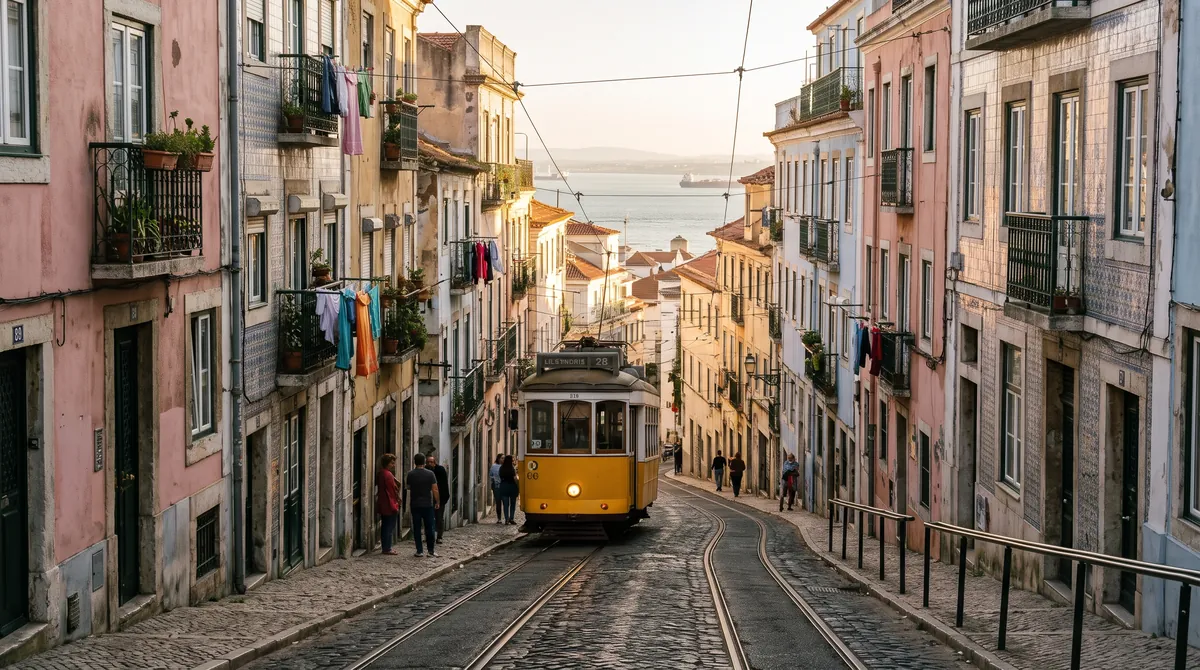
Board historic tram 28 early at its Martim Moniz terminus, before the queues build, and let the yellow carriage rattle up through tight curves to Graça. The Miradouro da Senhora do Monte and the terrace in front of the Graça church give wide views over the rooftops to the castle and the river.
- Afternoon
São Jorge castle, Santa Luzia and Portas do Sol
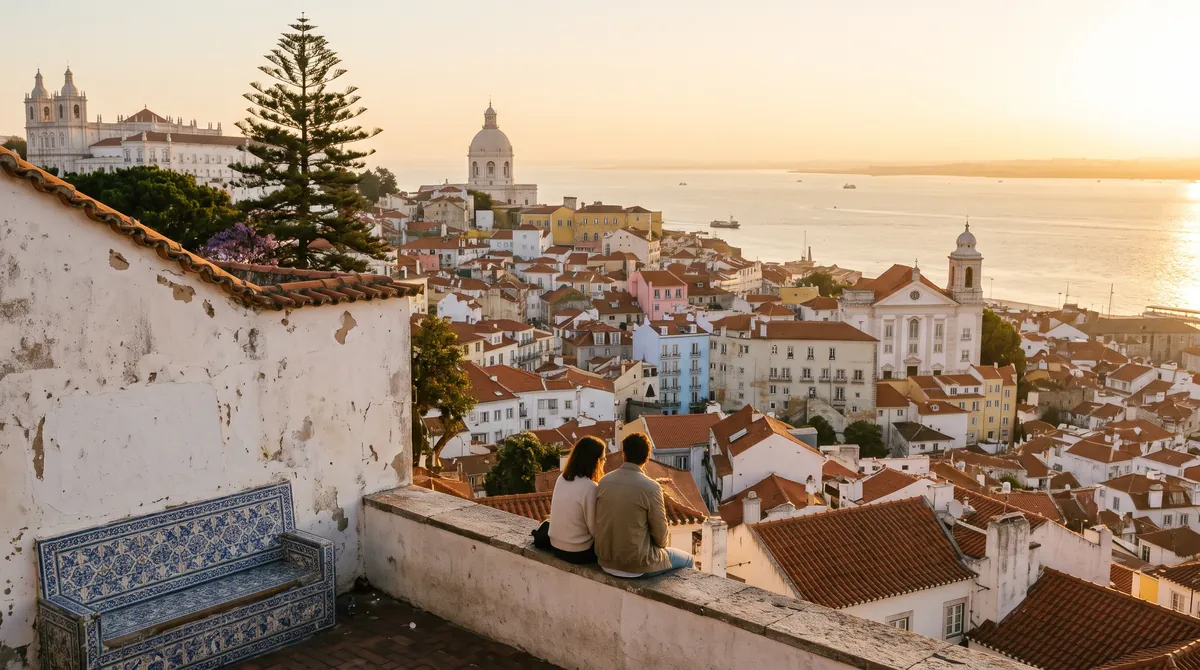
Walk on to São Jorge castle, whose ramparts and shaded courtyards look out over the whole city. Continue downhill to the Miradouro de Santa Luzia, with its tiled panels and bougainvillea, and the neighbouring terrace of Portas do Sol, the classic view over the roofs of Alfama to the Tagus.
- Evening
Fado in Alfama
Stay in Alfama and lose yourself in its stairways and tiny squares. This is the heartland of fado, the soulful song of Lisbon, recognised by UNESCO as intangible cultural heritage in 2011. Many small houses serve dinner with performances; when the singer begins, the room falls silent, and you should too.
Sunday Belém and the river
- Morning
Jerónimos Monastery
Head downriver to Belém early. The Jerónimos Monastery, a masterpiece of the ornate Manueline style, and the nearby Belém Tower were listed together by UNESCO in 1983. Arrive at opening time for the cloister, a lacework of carved stone that is at its most peaceful before the crowds.
- Afternoon
Pastries, the Monument to the Discoveries and Belém Tower
A few steps from the monastery, a historic bakery has been making pastéis de Belém since 1837, from a recipe linked to the monks; eat them warm with cinnamon and icing sugar. Then walk along the river to the Monument to the Discoveries, inaugurated in its present form in 1960, and on to the Belém Tower at the water’s edge.
- Evening
MAAT or the ferry to Cacilhas
Walk back east along the river past MAAT, the museum of art, architecture and technology that opened in 2016, and stroll across its curving, tiled roof. Or return to Cais do Sodré and take the ferry across the Tagus to Cacilhas, a crossing of about ten minutes, for the view back to the city glowing on its hills.
When to go
Lisbon is pleasant for much of the year. Spring and early autumn bring warm days that suit long walks, while July and August are hot and busy, best enjoyed early and late in the day. Winter is mild, and on clear days the low sun makes the pastel façades and tiled fronts glow.
In June the city celebrates its popular saints. On the night of 12 June, the eve of the feast of Santo António, who was born in Lisbon, the old quarters such as Alfama and Graça fill with street parties, music, paper garlands and the smell of grilled sardines. Small pots of basil, , are given as tokens of affection.
Group your days by neighbourhood instead, and the city unfolds in a natural order.
Small things that make the weekend easier
- Wear shoes with a good grip: the hills are steep and the limestone paving is often polished smooth.
- Load your navegante card with credit rather than single tickets, so one card works on metro, tram, bus and ferry.
- Ride tram 28 early or late in the day. When the queue at Martim Moniz is long, tram 12, which shares part of the route through the old town, is a good alternative.
- Arrive early at the Jerónimos Monastery and the Belém Tower, especially at weekends.
- Carry a light layer: evenings by the river can be breezy, even in summer.
Words in this article
- Miradouro
- A public viewpoint, often a terrace or small garden with benches, overlooking the city and the river.
- Fado
- Lisbon’s traditional song, often melancholy and accompanied by guitars, recognised by UNESCO as intangible cultural heritage in 2011.
- Calçada portuguesa
- Portuguese pavement of small limestone and basalt cubes, laid by hand in patterns.
- Pastéis de Belém
- The custard tarts made at the historic bakery in Belém since 1837; elsewhere the pastry is known as pastel de nata.
- Manjericos
- Small pots of basil given as tokens of affection during Lisbon’s June festivities.
Questions readers ask
Is a weekend enough for Lisbon?
A weekend is enough for a rewarding first taste if you group your days by neighbourhood. Spend one day in the Baixa and Chiado, one in Alfama and Graça with the castle, and one in Belém by the river. You will not see everything, but you will come away with a clear sense of the city and a good reason to return for Sintra or the coast.
How do you pay for public transport in Lisbon?
The simplest option is the reloadable navegante occasional card, still often called Viva Viagem, which you buy from machines at metro stations. Load it with credit, known as zapping, and it works on the metro, buses, trams and the ferries across the Tagus. Keep the card for your next visit, and check current fares and validity at the machines.
Where can you hear fado in Lisbon?
Alfama is the traditional home of fado, and many small houses in its lanes serve dinner with live performances in the evening. Bairro Alto has a similar tradition. Performances are intimate, usually a singer with two guitarists, and the audience listens in silence during each song. Booking ahead for a weekend evening is a good idea.