
Mallorca beyond the famous excursions
Formentor, Valldemossa and the Sóller train deserve their fame. Beside them, a country market, a stone village, a fishing harbour and a quiet island show another Mallorca.
The classic Mallorca day trips are classics for good reason. The road out to Cap de Formentor, the lanes of Valldemossa and the old wooden train from Palma to Sóller all deserve their place on a first visit. Yet the island is large and varied, and some of its most rewarding days lie a little to one side of the tour bus routes. The places below are not replacements for the famous excursions, but companions to them.
Country markets: Sineu and Santanyí
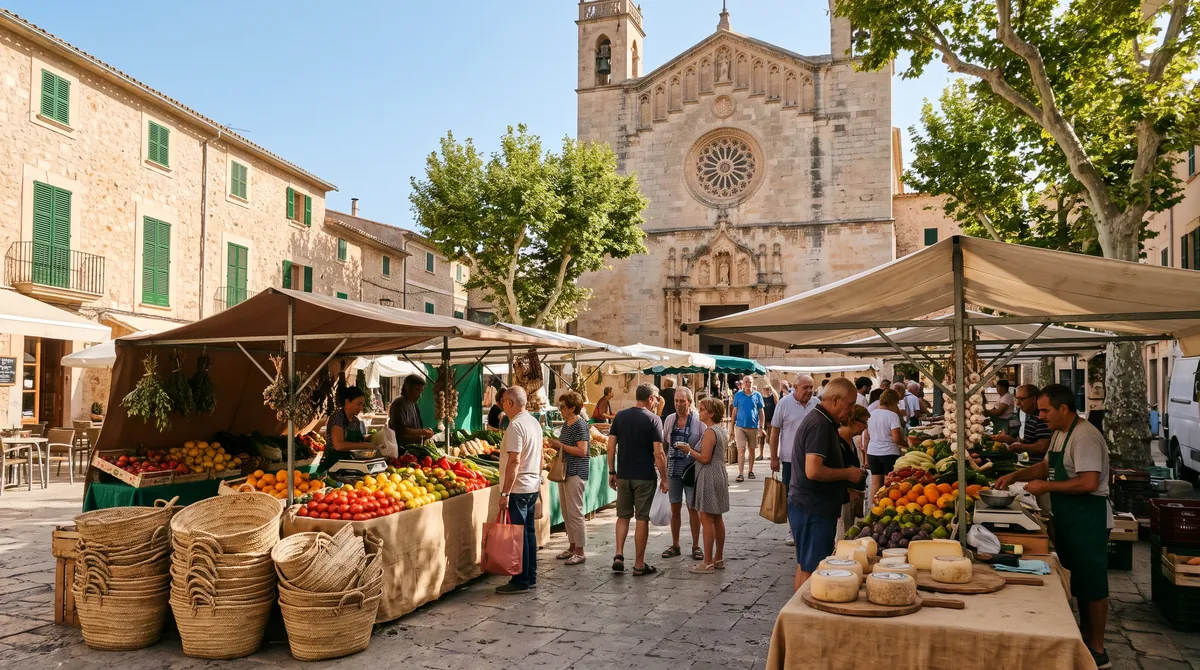
Sineu, in the flat heart of the island, holds its market every Wednesday morning. Its roots go back to 1306, when King Jaume II granted the town a market privilege, and it is often described as the oldest market on Mallorca. What sets it apart is the livestock section, where farmers still trade animals, alongside stalls of fruit, vegetables, local produce, baskets and household goods. Sineu also lies on the railway line from Palma to Manacor, which makes it an easy morning without a car. Arrive early to see the animal section at its liveliest, then linger over a coffee in the square as the stalls pack up.
In the southeast, Santanyí fills its main square and the surrounding streets with a market on Wednesdays and Saturdays. The old centre is built largely of warm, golden stone, and the Saturday market draws the larger crowd, so arrive early or choose the calmer Wednesday.
Stone villages and a fishing harbour
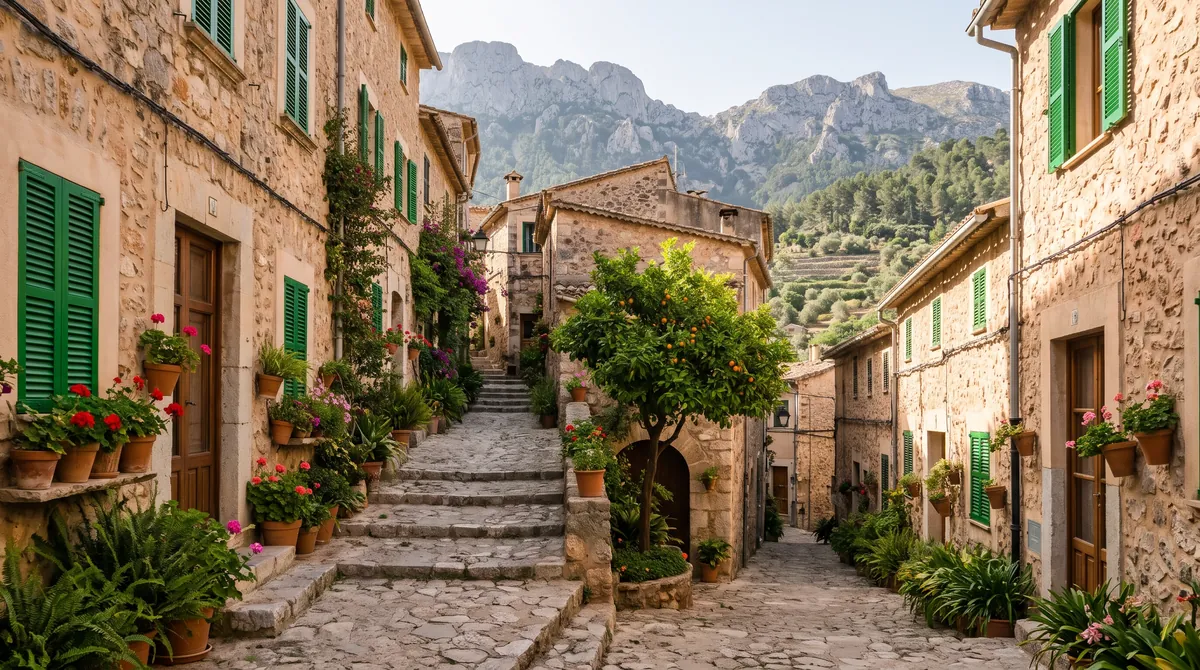
Above Sóller, Fornalutx climbs the slope in stepped lanes of stone, with potted plants by the doors and views over orange groves towards the highest peaks of the Tramuntana. You can reach it on foot from Sóller by way of the hamlet of Biniaraix, along old paths and quiet lanes through olive and citrus terraces, or drive up and park at the edge of the village.
If you have energy left, the stone path through the Biniaraix gorge, one of the finest old paths in the range, climbs from the hamlet between terraces towards the mountains. Even a short stretch shows how carefully these routes were built, step by step, for mules and farmers.
On the southeast coast, Cala Figuera is a working fishing harbour in a narrow, branching inlet. Boats are kept in , the traditional boathouses at the water’s edge, and a footpath follows the harbour round and up onto the low cliffs. Mornings are the quietest time, when the fishing boats come in and the light is soft on the water. Santanyí is only a short drive away, so the two combine naturally.
The places below are not replacements for the famous excursions, but companions to them.
Artà, Ses Païsses and the northeast
Artà, in the northeast, is a hill town crowned by the sanctuary of Sant Salvador, enclosed within old fortified walls. A long flight of steps lined with cypresses climbs from the parish church to the top, where the view stretches over rooftops, fields and the distant bay. There are around 180 steps, and the walk up is part of the pleasure. The town holds its own market on Tuesdays.
Just outside the town lies Ses Païsses, one of the best known talaiotic settlements on the island. Its massive stone entrance, the remains of a central tower and the ring of Cyclopean walls date from the first millennium BC. The tree-shaded site makes an unhurried visit even on a warm day.
Mountains, wetlands and a quiet island
High in the mountains between Sóller and Pollença, the sanctuary of Lluc has drawn pilgrims since the Middle Ages. It is home to a small dark statue of the Virgin, affectionately known as La , and to a boys’ choir founded in 1531, whose singers are called after their blue cassocks. Footpaths lead from the sanctuary into the surrounding holm oak woods.
Near the bay of Alcúdia, the S’Albufera natural park protects the largest wetland in the Balearic Islands and has been a natural park since 1988. Paths, hides and observation platforms look out over reed beds and lagoons where herons, egrets and many migrating birds gather. Visitors collect a permit at the visitor centre, and early morning is the best time for birds. The park is also recognised as a wetland of international importance under the Ramsar Convention.
From Colònia de Sant Jordi, authorised boats cross to the Cabrera Archipelago, a maritime and terrestrial national park since 1991. The crossing takes around an hour, visitor numbers are limited, and a day on the main island can include the small castle above the harbour, quiet coves and remarkably clear water. Many boat trips also stop at Sa Cova Blava, a sea cave where the water glows blue, for a swim when the sea is calm. Book ahead in summer and check the sea conditions.
How to make these days work
A few habits make the quieter side of Mallorca easier and more enjoyable, for you and for the villages you visit.
- Go early. Markets are liveliest in the first hours, and village streets are calmer before midday.
- Park outside villages. Many old centres have narrow lanes and little parking, so use the car parks at the edge and walk in.
- Respect the . In smaller towns many shops close in the early afternoon, and a slow lunch is the natural rhythm.
- Combine places that lie close together: Santanyí with Cala Figuera, Artà with Ses Païsses, Sóller with Fornalutx.
- Check current days and times for markets, boats and sites, which can change with the season.
Words in this article
- Escars
- Traditional boathouses at the water’s edge where Mallorcan fishermen keep their boats.
- Talaiot
- A prehistoric stone tower typical of Mallorca and Menorca, which gives its name to the talaiotic culture.
- Moreneta
- Affectionate name for the small dark statue of the Virgin venerated at the sanctuary of Lluc.
- Blauets
- The boys’ choir of the Lluc sanctuary, founded in 1531 and named after its blue cassocks.
- Siesta
- The early afternoon break when many shops in smaller Spanish towns close.
Questions readers ask
Can you visit these places without a car?
Some of them, yes. Sineu lies on the railway line from Palma to Manacor, and buses link Palma with towns such as Santanyí, Artà and Sóller. Fornalutx can be reached on foot from Sóller. For Cala Figuera, Lluc and S’Albufera a car gives more freedom, so check current bus timetables before planning a day without one.
What is the best season for these excursions?
Spring and autumn are ideal: markets are lively, the countryside is green or golden, and the roads are quieter than in high summer. S’Albufera is especially rewarding during the spring and autumn bird migrations. Boat trips to Cabrera depend on the sea, so the calmer months from late spring to early autumn are usually the most reliable.
How do you visit the Cabrera Archipelago?
Only by sea. Authorised passenger boats leave from Colònia de Sant Jordi, and the crossing takes around an hour. Visitor numbers in the national park are limited, so booking ahead is wise in summer. Private boats need prior authorisation from the park to navigate and anchor, and all crossings depend on the weather on the day.