
Market mornings: how to read a European food market
When to go, how to behave and what to eat on the spot: a visitor’s guide to city food markets, with portraits of six market halls from Málaga to Stockholm.
A city’s food market tells you more in an hour than a day of sightseeing. You see what grows nearby and what the sea brought in that morning, how people greet each other and what they will cook for dinner. Visiting well is a small art, though, and a few habits make the difference between wandering past the stalls and feeling part of the morning.
When to go
Markets belong to the morning. Traders set up early, the finest fish and produce sell first, and by early afternoon many stalls are wiping down their counters. Arrive between about nine and eleven for the fullest displays and the liveliest atmosphere, or earlier still if you want to watch the market wake up.
Check the calendar before you set out. Many market halls close on Sundays, some keep shorter hours on certain weekdays, and open-air markets often run only on fixed days. Saturdays tend to be the busiest and most sociable, weekdays the calmest. Opening days vary from city to city, so check current times locally.
How to behave at the stalls
- Look first. Walk the whole market before you buy, to see what is in season and where local shoppers queue.
- Ask before touching. In many markets the trader chooses and bags the produce for you; point, and let them pick.
- Find your place in the queue. At busy counters, take a number from the ticket machine, or in Spain ask “¿quién es el último?” to find out who is last in line.
- Carry small change. Cards are widely accepted, but coins and small notes speed things up at little stalls.
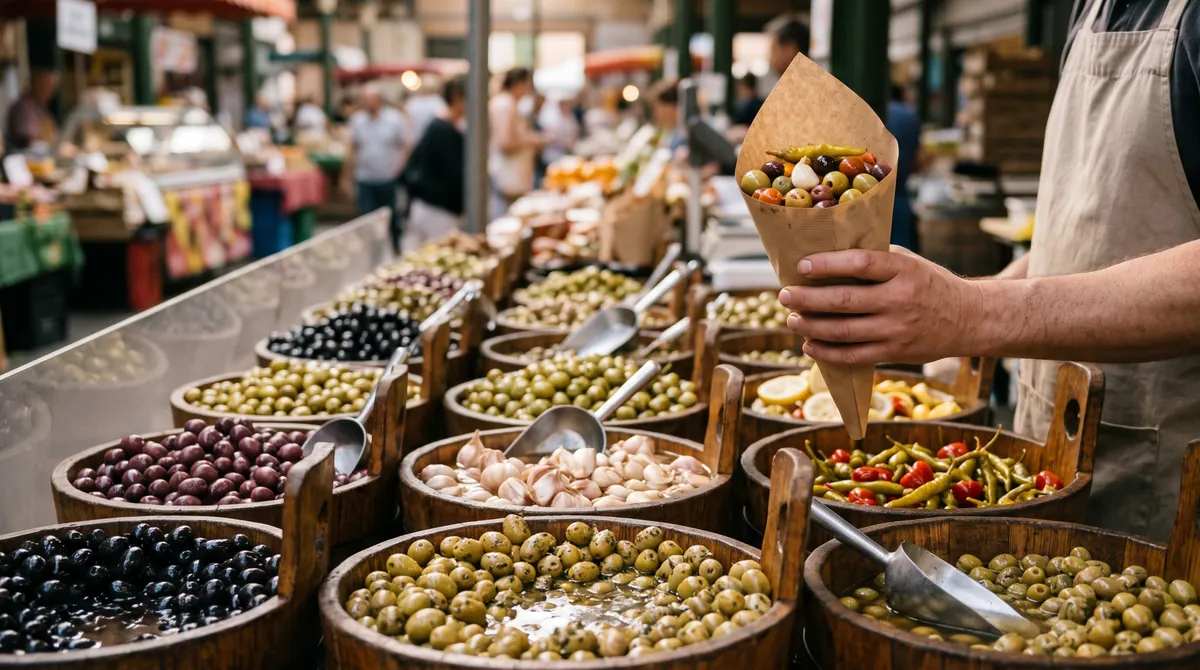
- Buy in small amounts. A few slices of ham, a single wedge of cheese or a handful of olives is a perfectly normal order.
- Bring your own bag, and greet the trader with a simple hello in the local language.
Photographs are part of the pleasure, but a busy counter is someone’s workplace. Buy something first or ask with a smile, and step aside for regular shoppers with their baskets and trolleys.
What to eat on the spot and what to take away
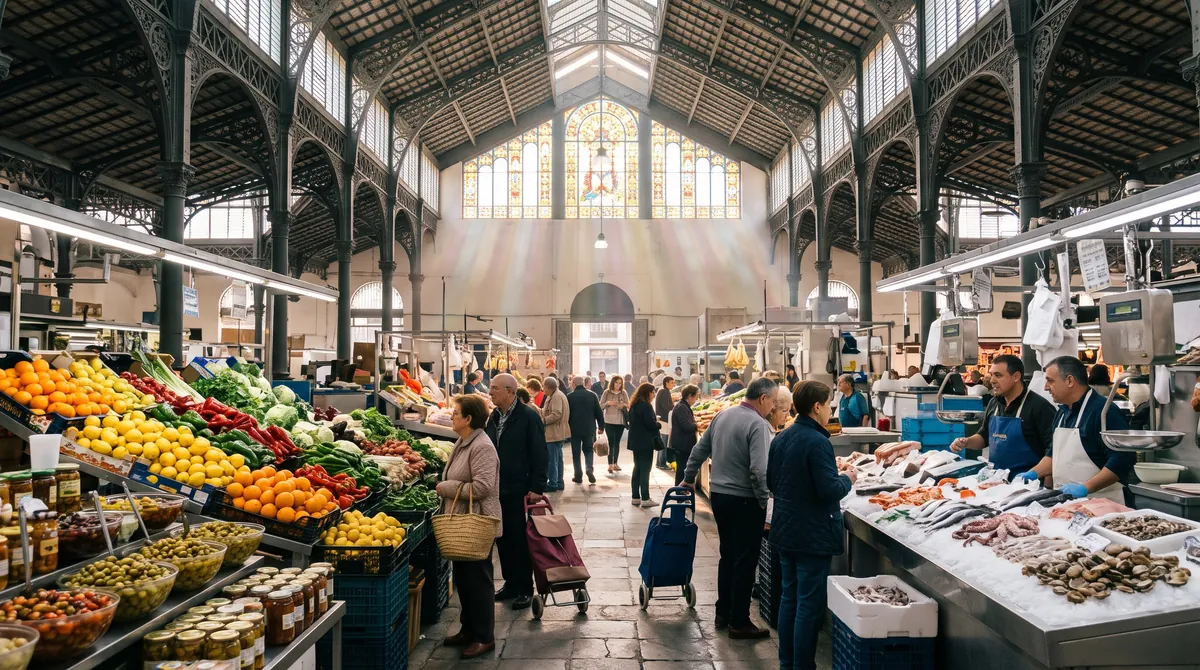
Most large market halls now have counters where you can eat standing or perched on a stool: fried fish, oysters, a bowl of soup, a glass of wine. A meal where the produce is sold is often the freshest in town. Late morning, when traders themselves stop for a bite, is a good moment to join them. The seasons show most clearly at the fruit and vegetable stalls: strawberries and asparagus in spring, tomatoes and stone fruit in summer, mushrooms and chestnuts in autumn, citrus in winter.
For the journey home, think of foods that travel well: hard cheeses, cured ham and sausages, olives, spices, tea, honey and tinned fish. Leave soft cheeses and fresh seafood for a picnic in the city. Many stalls will vacuum pack cured meats and cheese if you ask.
Southern markets: Málaga, Palma and Lisbon
In the south, markets keep the rhythm of the Mediterranean day: early starts, lively mid-mornings and a slow wind-down towards lunch. Fish counters take centre stage, and the bars inside are often busy with traders and shoppers having a coffee or a first small glass of wine before noon.
Mercado Central de Atarazanas, Málaga. The iron and glass hall was built between 1876 and 1879 on the site of a Moorish shipyard, and you enter through its surviving fourteenth century gate, a horseshoe arch of pale marble. Inside, look for local almonds, olives, goat’s cheese and the morning catch from the Mediterranean. The market opens from Monday to Saturday.
Mercat de l’Olivar, Palma. Palma’s central market hall opened in 1951 and was renovated in the early 2000s. It gathers fruit, vegetables, cheeses and Mallorcan under one roof, with a large fish section and counters for a late morning bite. Like many Spanish markets, it closes on Sundays.
Mercado da Ribeira, Lisbon. Opened in 1882 near Cais do Sodré, this hall close to the river has two personalities. One side remains a working market, at its liveliest early in the morning with fish, fruit, vegetables and flowers; since 2014 the other has housed a large food hall with dozens of counters.
Northern markets: Vienna, Stockholm and Hamburg
Further north, market halls lean towards cheese, smoked fish, bread and seasonal produce, and many double as places for a sit-down lunch. Open-air markets carry on through the cooler months, with stallholders in thick jackets and shoppers warming their hands around a hot drink.
Naschmarkt, Vienna. Vienna’s best known market stretches along the above the covered Wien River, where its first pavilions were built in 1902. The rows of stalls sell spices, olives, cheese, pickles and fruit, and on Saturdays a flea market spreads out alongside, a tradition since 1977.
Östermalms , Stockholm. Opened in 1888 and designed by the architects Gustaf Clason and Kaspar Salin, this brick market hall is one of the city’s classic addresses for food. After a long renovation, during which traders moved to a temporary hall on the square outside, it reopened in 2020. Come for Swedish cheeses, smoked fish, shellfish and game.
Isemarkt, Hamburg. Twice a week, on Tuesdays and Fridays, around 200 stalls line up beneath the iron viaduct of the U3 between the stations Hoheluftbrücke and Eppendorfer Baum. The railway overhead keeps traders and shoppers dry, and the market stretches for several hundred metres, with regional produce, flowers, fish and cheese.
A city’s food market tells you more in an hour than a day of sightseeing.
Words in this article
- Saluhall
- Swedish for market hall, a covered building where traders sell fresh food from permanent stalls.
- Sobrassada
- A soft, spreadable cured pork sausage from Mallorca, seasoned with paprika.
- Nasrid
- The last Muslim dynasty of al-Andalus, which ruled from Granada until 1492.
- Wienzeile
- The long road along the Wien River in Vienna, beside which the Naschmarkt stretches.
Questions readers ask
What is the best time to visit a food market?
Go in the morning, ideally between about nine and eleven, when the stalls are fully stocked and the atmosphere is at its liveliest. Early risers can watch traders set up, while late morning is ideal for eating at the counters. Many markets close on Sundays and some keep shorter hours on certain days, so check current times before you go.
Can you pay by card at European food markets?
Card payments are widely accepted, especially in large market halls and at food counters. Small stalls and open-air markets may still prefer cash, and coins or small notes make quick purchases easier for everyone. Carrying a little change alongside your card is the simplest way to be ready for any stall, from a fishmonger to a flower seller.
Is it all right to take photos at market stalls?
Usually yes, as long as you are considerate. Remember that a busy counter is someone’s workplace, so avoid blocking the queue and step aside for regular shoppers. Buying something first, or simply asking with a smile, makes traders happy to let you photograph their displays, and it often starts a friendly conversation about what is in season.