
A Transylvanian retreat: Saxon villages, meadows and slow days
Fortified churches, flower meadows and cows walking home at dusk: how to spend three to five quiet days in the Saxon villages between Sibiu and Sighișoara.
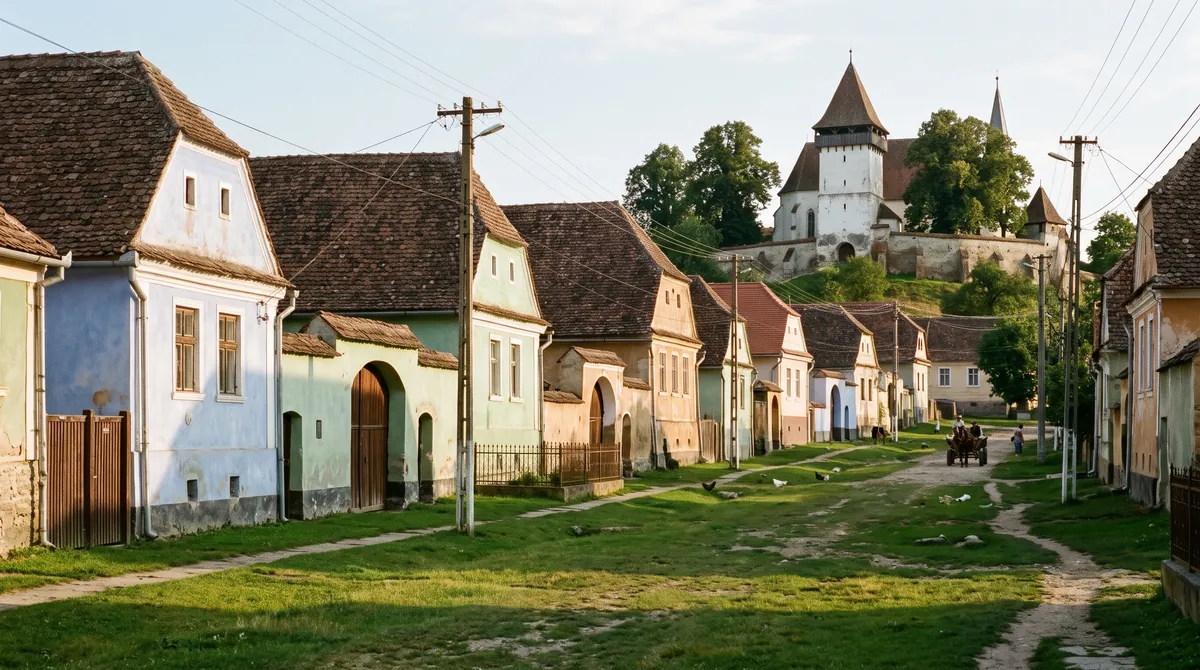
In the rolling hills of southern Transylvania, between Sibiu and Sighișoara, the old Saxon villages keep a rhythm that feels far removed from city life. Long streets of painted farmhouses lead up to fortified churches, horse carts share the lanes with walkers, and meadows run on to the edge of oak woods. Three to five days here are less about sights than about slowing down.
Saxon villages and their fortified churches
German-speaking settlers, known as the , came to the region from the 12th century, invited by King Géza II of Hungary. They built compact villages of gabled houses along a main street, and at the centre of each stood its church, ringed by walls and towers where the whole community could gather. These Kirchenburgen, or fortified churches, are still the heart of village life.
Of the roughly 300 fortified churches once found in Transylvania, more than 150 survive. Seven villages with fortified churches, built between the 13th and 16th centuries, form a UNESCO World Heritage Site: Biertan was inscribed in 1993, and in 1999 the listing was extended to Câlnic, Dârjiu, Prejmer, Saschiz, Valea Viilor and Viscri.
Viscri, in Brașov County, is many visitors’ favourite. Its German name is Deutsch-Weißkirch, in which Weißkirch means white church, and the church itself, with origins around 1100 and towers added in the 16th century, sits inside rings of walls above the village. Biertan, about 21 kilometres east of Mediaș, has an imposing late Gothic church begun in the 1490s and completed around 1522. It was the seat of the Lutheran bishops of Transylvania from 1572 to 1867, and one of its doors has an intricate lock that won a prize at the Paris World Exhibition in 1900.
Meadows, haymaking and the rhythm of the day
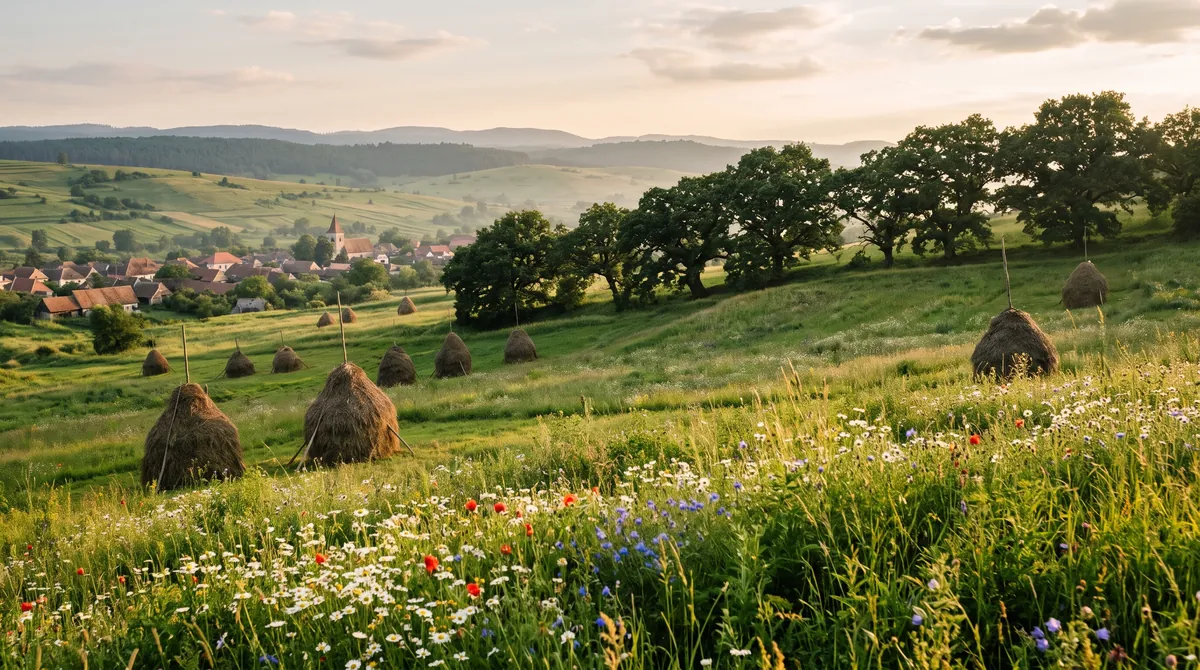
The hills around Sighișoara and the Târnava Mare valley are among the most important traditionally farmed landscapes in Europe. Around 89,000 hectares belong to the network of protected sites, a patchwork of hay meadows, dry grasslands and oak and hornbeam woods spread across four counties. In early summer, before the hay is cut, the meadows are thick with wild flowers and the air hums with insects.
Village days follow the seasons. Hay is still often cut and turned by hand, horse carts bring it home in tall, swaying loads, and in the early evening the cows walk back along the main street, turning in at their own gates. There is little to do and a great deal to watch.
There is little to do and a great deal to watch.
Many guests come precisely for that quiet. With no timetable and the phone left in a drawer, evenings stretch out on a bench by the gate, the light fades slowly over the hills and, on clear nights, the sky fills with stars. Many people find this simple routine wonderfully calming.
Farmhouse stays and village food
Guesthouses in restored farmhouses are the classic way to stay. Expect thick walls, wooden floors, tiled stoves for the cooler months and gardens planted with fruit trees, often looked after by families who live in the village. Many have only a handful of rooms, which suits the pace of the place.
Meals are one of the great pleasures of a stay. Bread comes from wood-fired ovens, cheese from the village and honey and fruit from the gardens. Breakfast might bring , a spread of roasted aubergines and peppers, alongside homemade , whole fruit preserved in syrup. Dinner is often a generous soup, a slow-cooked stew and a homemade cake, served outside on warm evenings.
Sibiu and Sighișoara: two gateways
Sibiu, European Capital of Culture in 2007 together with Luxembourg, makes a graceful start or finish. Its old town is built around the Large Square and the Small Square, and many roofs carry small dormer windows that look like half-closed eyes, which gives it the nickname “the town with eyes”. The Brukenthal National Museum, opened to the public in 1817, fills its founder’s palace, and the ASTRA open-air museum spreads across 96 hectares of the Dumbrava forest just south of town.
Sighișoara’s historic centre, a walled citadel on a hill, has been a UNESCO World Heritage Site since 1999. The 64 metre Clock Tower now houses a history museum, towers named after craft guilds such as the tailors and the tinsmiths still stand along the walls, and a covered wooden stairway, the Scholars’ Stairs, climbs to the Gothic Church on the Hill.
Planning three to five slow days
Choose one village as your base rather than moving every night. A simple shape works well:
- First day: arrive, unpack and walk the length of the village, ending at the fortified church.
- Next days: walk or cycle across the hills to a neighbouring village, with a picnic in the meadows.
- One day in town: spend a day in Sibiu or Sighișoara for museums, squares and a long lunch.
- Last day: plan nothing at all, read in the garden and watch the cows come home one final time.
Old cart tracks link many of the villages across the hills, and walks of two to five hours between neighbouring villages are a fine way to spend a day. Your hosts will know the best routes and can often arrange a lift back.
Getting there and when to go
Sibiu and Târgu Mureș both have airports, and the airport near Brașov welcomed its first commercial flights in 2023, so the villages can be reached from several directions. Many guesthouses can arrange a transfer, or you can hire a car, which makes it easy to explore the smaller villages at your own pace.
Late spring to early autumn is the loveliest time. May and June bring the meadows into flower, summer days are long and warm, and September adds the harvest, orchards heavy with fruit and a soft, golden light over the hills.
Words in this article
- Kirchenburg
- German for fortified church, a village church surrounded by defensive walls and towers.
- Transylvanian Saxons
- German-speaking settlers who came to Transylvania from the 12th century and built its fortified church villages.
- Natura 2000
- The European Union’s network of protected natural sites, which includes the Târnava Mare hills.
- Zacuscă
- A Romanian spread of roasted aubergines and peppers, often made at home in autumn.
- Dulceață
- A Romanian preserve of whole fruit in syrup, served at breakfast or with cake.
Questions readers ask
How many days should you plan for a stay in the Saxon villages?
Three to five days works well. Choose one village as a base, spend two or three days walking or cycling to neighbouring villages, and keep one day for Sibiu or Sighișoara. A final day with nothing planned is part of the appeal: it gives you time to sit in the garden, read and simply enjoy the rhythm of the village.
When are the hay meadows in flower?
The meadows are at their most colourful in late spring and early summer, roughly May and June, before the hay is cut. The exact timing depends on the weather each year. Later in summer you can watch haymaking, often still done by hand, and September brings the harvest, ripe fruit in the orchards and soft autumn light.
How do you reach the Saxon villages?
Sibiu and Târgu Mureș both have airports, and the airport near Brașov opened to commercial flights in 2023. From there, many guesthouses can arrange a transfer, or you can hire a car to explore the smaller villages at your own pace. Sibiu and Sighișoara make good starting points.