
Tuscany’s thermal springs: warm water in the southern hills
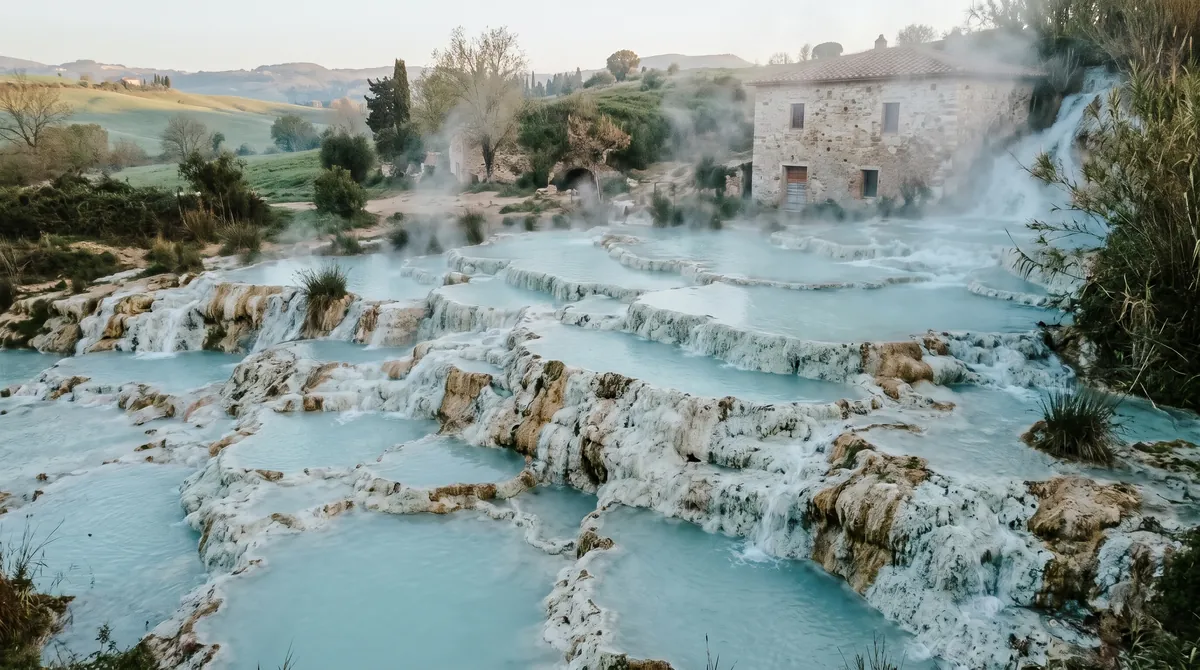
In the hills of southern Tuscany, warm water rises from the ground: a village square full of steam, white stone pools in the woods and the waterfall pools of Saturnia.
Southern Tuscany is not only cypresses, vineyards and hill towns. Beneath the soft hills of the Val d’Orcia and the slopes of Monte Amiata, warm water rises from the ground, spills over pale stone and gathers in pools that people have enjoyed since Etruscan and Roman times. A few slow days here combine thermal water with some of Italy’s most celebrated countryside.
Warm water with a long history
The Etruscans and the Romans already knew these springs, and the habit of bathing never quite left the region. Bagno Vignoni lies close to the , the old pilgrim route to Rome, and its visitors over the centuries included Saint Catherine of Siena, Lorenzo de’ Medici and Pope Pius II. Today the Italian word you will see everywhere is , thermal baths.
Several of the springs are sulphurous, and the water leaves the ground hot. As it cools and flows, it deposits , a pale limestone that slowly builds ledges, terraces and basins. The result is a landscape of milky blue water and white stone that looks almost sculpted.
Bagno Vignoni: a square of steam
Bagno Vignoni, a small village belonging to San Quirico d’Orcia, has a thermal pool where most villages have a piazza. The , the square of the springs, is almost entirely taken up by a large rectangular basin of sixteenth-century origin, fed by the spring and framed by old stone houses.
Bathing in the square is no longer possible, so this is a pool to look at rather than to swim in. Come early on a cool morning, when steam drifts across the surface and the reflections of the houses waver in the water.
Below the village, the water runs on through the Parco dei Mulini, the park of the mills, towards the River Orcia. Here four medieval mills were cut into the rock, first recorded in 1207; because the warm spring never ran dry, they kept turning in summer when other mills stood still. For a soak, the village has spa facilities with thermal pools, each with its own house rules.
Bagni San Filippo and the white whale
A short drive south, on the slopes of Monte Amiata, Bagni San Filippo belongs to Castiglione d’Orcia. It takes its name from Saint Philip Benizi, who according to legend came here in the thirteenth century. From the village, a path leads into the woods along the Fosso Bianco, the white stream, which carries thermal water for about two kilometres.
The banks of the stream are coated in white travertine, and the best known formation, the or white whale, rises above the water like a frozen cascade. Small pools in the forest are free to use, and because the water leaves its source at about 48 °C, bathing is possible even out of season.
The white formations are delicate. Admire them without climbing, walking or sitting on them, and choose a pool away from the formations themselves. Many people find the sound of running water among the trees as restful as the warmth.
Saturnia and Petriolo
Further south-west, in the Maremma near the village of Saturnia, the Cascate del Mulino tumble over a series of travertine terraces beside an old mill. The spring releases around 800 litres a second, the water arrives at about 37 °C and the natural pools are free to visit. Saturnia itself is one of the oldest towns in Tuscany: the Etruscans called it Aurinia.
Petriolo lies in the valley of the River Farma, on the border between the provinces of Siena and Grosseto. Hot water at about 43 °C rises beside the river and the stone walls of a fortified bathing complex from the early fifteenth century, visited in its day by the Medici, the Gonzaga and Pope Pius II. The springs can be enjoyed freely by the river, in a quieter setting than Saturnia.
Winter mornings have their own magic: steam rises thickly from the warm water into the cold air.
The landscape between the springs
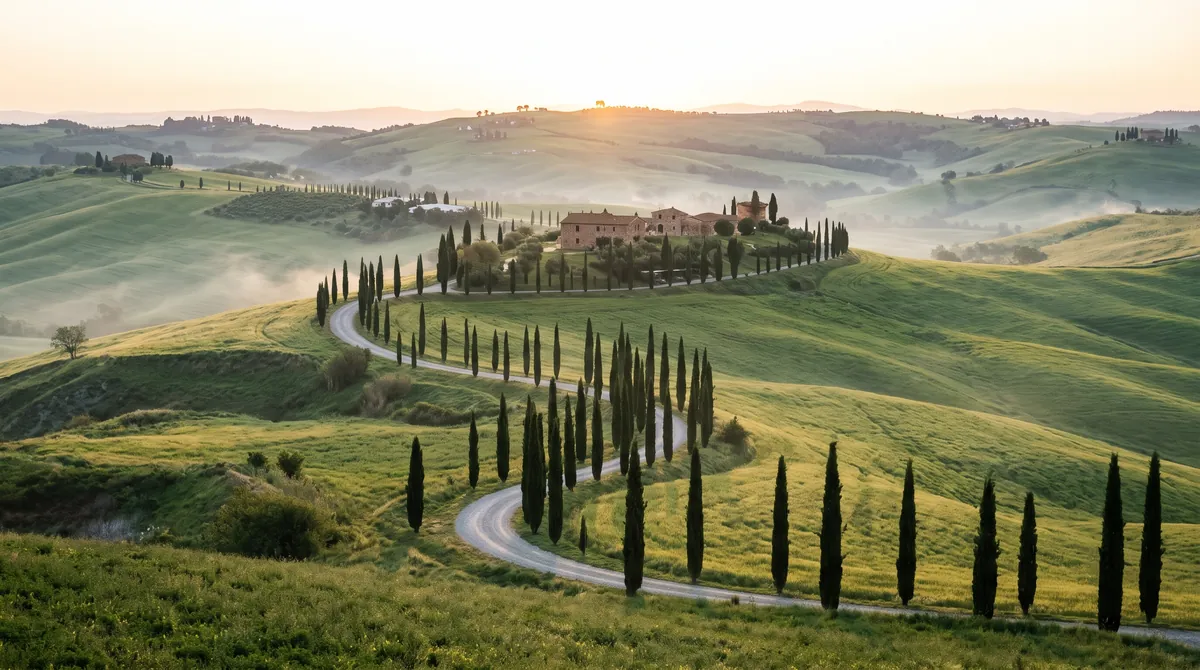
The springs sit in some of Italy’s most admired countryside. The Val d’Orcia was inscribed on the UNESCO World Heritage List in 2004 as a cultural landscape of rolling hills, farmhouses on ridges and lines of cypress trees along winding roads. In late afternoon light, the hills turn gold and the cypresses cast long shadows.
Pienza, the birthplace of Pope Pius II, was rebuilt at his wish as an ideal Renaissance town, and its historic centre has been a World Heritage Site since 1996. From the garden of Palazzo Piccolomini, the view runs across the valley to Monte Amiata. Montalcino, on its own hill to the west, is home to Brunello di Montalcino, one of Italy’s most prestigious red wines.
A car is the easiest way to move between the springs, since buses in the valley are infrequent and there is no regular railway. Base yourself in the Val d’Orcia for Bagno Vignoni and Bagni San Filippo, and plan Saturnia and Petriolo as separate day trips.
Etiquette, seasons and what to bring
The free pools are shared spaces, and a little care keeps them lovely for everyone. Go early in the morning or outside the summer holidays, when the pools are calm. Take nothing but photographs, leave no rubbish and keep soap, shampoo and glass away from the water.
The sulphur gives the air a distinct smell of eggs, which you stop noticing after a few minutes. Leave silver jewellery in your bag, since sulphur tarnishes it. In spa facilities, house rules apply: swimwear is required, bathrobes and flip-flops are the norm and some pools ask for a swimming cap.
- Water shoes for slippery travertine and stony stream beds
- A towel and a warm layer for after the bath
- A bottle of drinking water
- A bag to carry your rubbish home
Spring and autumn are the loveliest seasons, with green or golden hills and mild air. Summer days are hot and the free pools are busy, so come at dawn or in the evening. Winter mornings have their own magic: steam rises thickly from the warm water into the cold air, and you may have the pools almost to yourself.
Words in this article
- Terme
- Italian for thermal baths, used for spa facilities built around warm springs.
- Travertine
- A pale limestone deposited by mineral-rich spring water as it cools and flows.
- Balena Bianca
- Italian for white whale, the large white travertine formation at Bagni San Filippo.
- Via Francigena
- The old pilgrim route to Rome, which passes close to Bagno Vignoni.
- Piazza delle Sorgenti
- The square of the springs in Bagno Vignoni, almost filled by a large thermal pool.
Questions readers ask
Can you bathe in the square at Bagno Vignoni?
No. The large pool in the Piazza delle Sorgenti is for looking at, and bathing in it is no longer possible. It is at its most atmospheric on a cool morning, when steam drifts over the water. For a soak, the village has spa facilities with thermal pools, while free pools can be found at Bagni San Filippo and Saturnia.
Are the hot springs in southern Tuscany free?
Several are. The pools in the woods at Bagni San Filippo, the Cascate del Mulino near Saturnia and the springs by the River Farma at Petriolo can all be enjoyed without a ticket. Spa facilities, such as those in Bagno Vignoni, charge for entry and have their own house rules, including swimwear and often a swimming cap.
When is the best time to visit Tuscany’s hot springs?
Spring and autumn are ideal, with mild weather, green or golden hills and fewer visitors. Summer is hot and the free pools are busy, so go at dawn or in the evening. Winter mornings are wonderfully atmospheric, with steam rising into the cold air, and the warm water makes even a chilly day comfortable.