3 days in Düsseldorf: the Rhine, the Altstadt and art
Three days on the Rhine, from the Altstadt and its brewery houses to the Königsallee, great art collections, the Gehry buildings in the MedienHafen and a palace by the river.
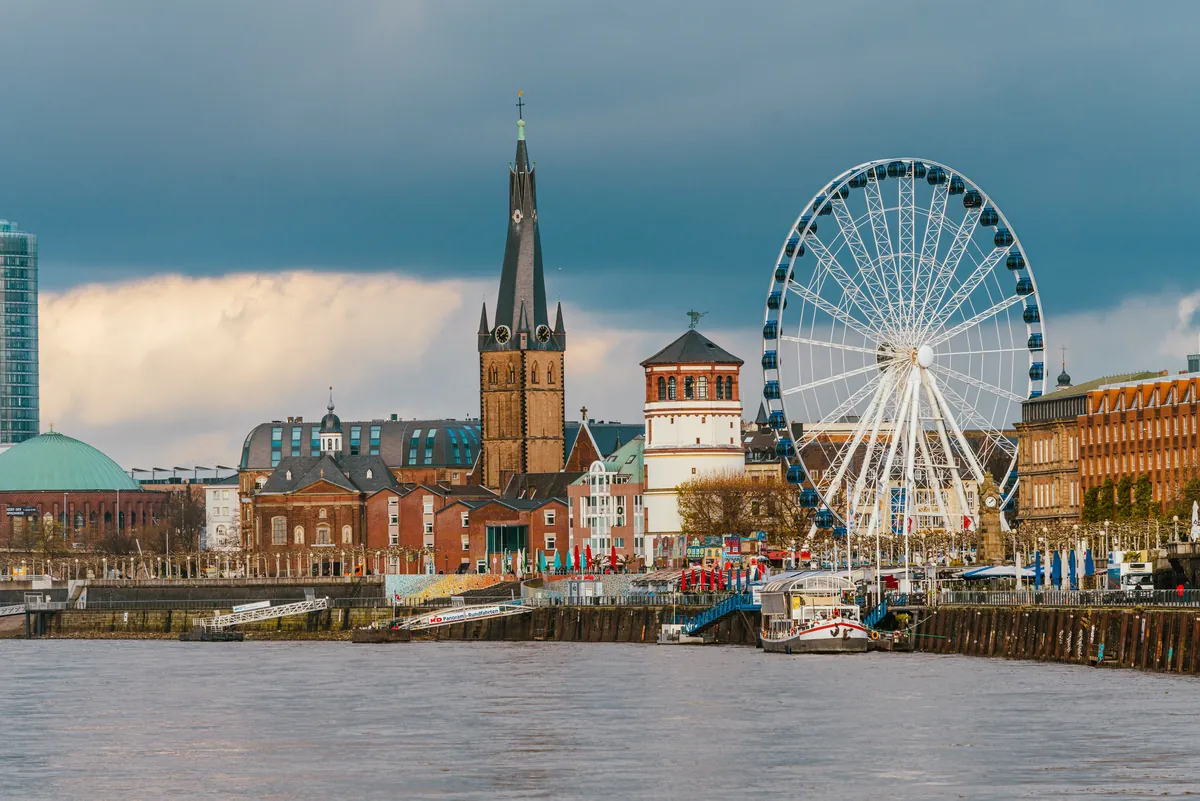
Düsseldorf lives along the Rhine. Its compact Altstadt runs down to a broad riverside promenade, its elegant boulevard follows a tree-shaded canal, and its museums hold some of the finest modern art in Germany. Three days give you old-town brewery houses, art and architecture, a Rhine-side village with an emperor’s ruined palace and a pink Baroque palace in a park.
A city on the Rhine
The Altstadt is small enough to cross in a quarter of an hour, yet it holds the city’s oldest stories. On the Burgplatz, the Schlossturm is all that survived when the old castle burned in 1872, and today it houses a maritime museum. Nearby, the twisted spire of St Lambertus rises above the rooftops.
The , the cartwheeling children, are the city’s best-loved symbol. A bronze fountain on the Burgplatz, made in 1954, shows two boys in mid-wheel, and competitions for young cartwheelers have been held since 1937. Nobody knows for certain how the tradition began, which only adds to its appeal.
The Altstadt is also the home of , a dark, copper-coloured beer brewed with top-fermenting yeast. Several traditional brewery houses still brew it on the premises and serve it in small, straight glasses. Düsseldorf has made mustard since the 18th century, and the sharp, dark local style, called in dialect, turns up on many plates beside hearty Rhineland dishes.
Getting there, getting around and where to stay
Düsseldorf Airport lies just north of the city. An S-Bahn station beneath the terminal has trains to the Hauptbahnhof in about 12 minutes, while the SkyTrain, a suspended monorail, links the terminal with the airport’s long-distance railway station in a few minutes.
In town, distances are short, and most sights in the centre lie within walking distance of one another. The Rheinbahn runs trams, light rail and buses on a single ticket system, useful for reaching the MedienHafen, Benrath or Kaiserswerth.
Stay in or near the Altstadt to be close to the river and the brewery houses, in the Carlstadt around the Carlsplatz market for quieter 18th-century streets, near the Königsallee for elegance, or by the MedienHafen for contemporary architecture and river views.
Three days, hour by hour
Day one Altstadt and the Rhine
- Morning
Carlsplatz market
Begin at the Carlsplatz market in the Carlstadt, open from Monday to Saturday. Stalls sell flowers, cheeses, fish, fruit and local specialities, including jars of sharp Düsseldorf mustard, and several counters serve coffee or a small breakfast to eat standing up among the shoppers.
- Afternoon
Marktplatz, Burgplatz and the old town lanes
Walk to the Marktplatz, where the old town hall faces the bronze equestrian statue of Jan Wellem by Gabriel de Grupello, unveiled in 1711 and counted among the finest Baroque sculptures north of the Alps. Continue to the Burgplatz, with the Schlossturm and the cartwheelers’ fountain, then follow the lanes towards St Lambertus.
- Evening
Rhine promenade and a brewery house
Stroll along the Rhine promenade as the sun sinks over the meadows on the far bank and the steps by the water fill with people. Then step into one of the traditional brewery houses of the Altstadt for a glass of Altbier and a hearty Rhineland plate with mustard on the side.
Day two The Kö, art and the harbour
- Morning
Königsallee and the Hofgarten
Walk the Königsallee, known simply as the Kö, where trees shade a long canal laid out with the boulevard in the early 1800s. At its northern end, cross into the Hofgarten, laid out from 1769 by Nicolas de Pigage and often described as Germany’s first public park.
- Afternoon
K20 and the Kunstpalast
Spend the afternoon with art. K20 on the Grabbeplatz shows the state collection of 20th-century art, including around a hundred works by Paul Klee. Then walk through the Hofgarten towards the river to the Kunstpalast at the Ehrenhof, whose collections range from old masters to glass and contemporary art.
- Evening
MedienHafen and the Rheinturm
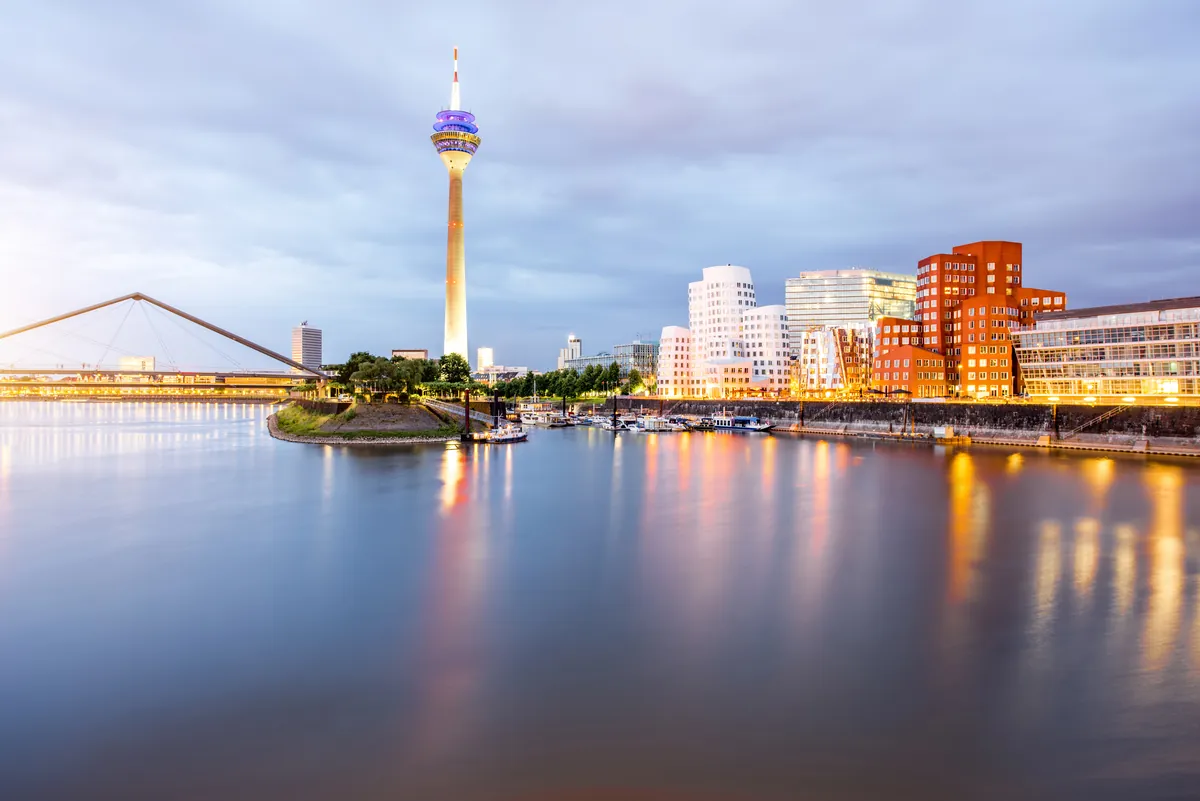
Follow the promenade south to the MedienHafen, where the three curving buildings of the Neuer Zollhof, designed by Frank Gehry and finished in the late 1990s, lean towards the water in white plaster, gleaming steel and red brick. Next to them, the light-sculpture clock on the Rheinturm counts the hours, minutes and seconds after dark.
Day three Emperors, palaces and Japan
- Morning
Kaiserswerth
Take the U79 north to Kaiserswerth, a quiet village of old houses on the Rhine. By the water stand the ruins of the Kaiserpfalz, the imperial palace that Emperor Barbarossa had built as a fortress in the 12th century, with walls up to 4.5 metres thick. A small ferry crosses the river to the other bank.
- Afternoon
Benrath Palace and park
Head south by S-Bahn to Benrath, a pink Baroque pleasure palace that Nicolas de Pigage designed for Elector Carl Theodor from 1755. Walk around the long mirror pond and along the avenues cut through the former hunting woods, where formal and landscape gardens sit side by side.
- Evening
Immermannstrasse and the Japanese quarter
End in the Japanese quarter around Immermannstrasse, between the Hauptbahnhof and the city centre. Düsseldorf is home to one of the largest Japanese communities in Europe, and the streets here are lined with noodle bars, bakeries, bookshops and food stores, a fine place for a relaxed final dinner.
Art, gardens and riverside villages
For a city of its size, Düsseldorf holds an unusual wealth of art. The state collection of North Rhine-Westphalia shows 20th-century classics at K20 on the Grabbeplatz and contemporary work at K21 in the Ständehaus, a former parliament building beside a pond in the south of the centre. The Kunstpalast adds centuries of painting and a celebrated glass collection.
The parks are part of the same story. The Hofgarten was laid out from 1769 for Elector Carl Theodor and later grew into the landscape park you walk through today, leading from the Königsallee almost to the Rhine. Further north, the Nordpark holds a Japanese garden, a calm counterpoint to the city’s busy shopping streets.
At the edges of the city, history reaches further back. Kaiserswerth grew up around a monastery founded around 700 on what was then a Rhine island, and in the 19th century the pastor Theodor Fliedner opened a deaconess institute there, where Florence Nightingale trained in 1851. Benrath, by contrast, was built purely for pleasure, as a country retreat for the elector.
Düsseldorf lives along the Rhine.
When to go
Spring and summer are the seasons of the Rhine meadows and the riverside steps, when the city spends its evenings by the water. Autumn brings mild walking weather and a full cultural calendar, and from late November Christmas markets fill squares across the city centre with lights and wooden stalls.
Carnival is the city’s other great season. It opens on 11 November and builds to , the Monday before Ash Wednesday, when a long parade of floats, bands and costumed groups winds through the centre and sweets are thrown into the crowds lining the streets.
Words in this article
- Altbier
- A dark, copper-coloured, top-fermented beer, the traditional brew of Düsseldorf’s Altstadt.
- Radschläger
- Düsseldorf’s cartwheeling children, the city’s best-loved symbol and the subject of a fountain on the Burgplatz.
- Mostert
- Dialect word for Düsseldorf’s sharp, dark mustard, made in the city since the 18th century.
- Kö
- Short name for the Königsallee, the elegant boulevard along a tree-lined canal.
- Rosenmontag
- Rose Monday, the high point of carnival, with a long parade through the city.
Questions readers ask
How do you get from Düsseldorf Airport to the city centre?
An S-Bahn station beneath the terminal has trains to the Hauptbahnhof in about 12 minutes. Alternatively, the SkyTrain, a suspended monorail, takes you from the terminal to the airport’s long-distance station, where regional and intercity trains stop. From the Hauptbahnhof, trams and light rail run by the Rheinbahn reach the Altstadt and the Königsallee in minutes.
What is Altbier?
Altbier is Düsseldorf’s traditional beer, dark and copper-coloured, brewed with top-fermenting yeast and then matured cool. Several traditional brewery houses in the Altstadt still brew it on the premises and serve it in small, straight glasses. Try it with a hearty Rhineland dish and a dab of the sharp local mustard, known in dialect as Mostert.
When is carnival in Düsseldorf?
The carnival season opens on 11 November and reaches its height in the days before Ash Wednesday. The highlight is Rosenmontag, the Monday before Ash Wednesday, when a long parade of floats, bands and costumed groups moves through the city centre and sweets are thrown to the crowds. The exact dates change each year with the date of Easter.