
3 days in Palma: cathedral, old town patios and the Sóller train
A Gothic cathedral on the shore, stone courtyards, a round castle in the pines and a wooden train over the mountains: three unhurried days in Mallorca’s capital.
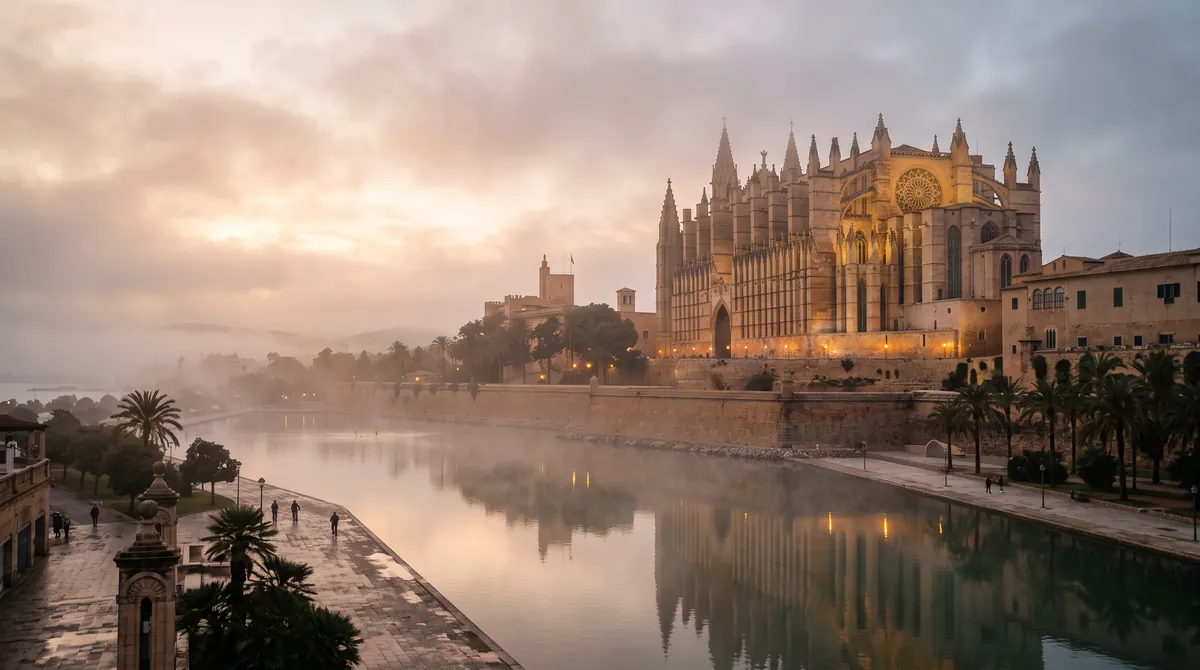
Palma is a capital where a Gothic cathedral stands almost on the shoreline. Three days are enough to see it properly: the cathedral and the royal palace beside it, the courtyards and Moorish baths of the old town, a round castle in the pines, a museum built into the old city walls, and a day out on the wooden train that has crossed the mountains to Sóller since 1912.
A cathedral by the sea and a city of patios
, as the people of Mallorca call their cathedral, was begun after the conquest of 1229 and completed in 1601. It rises above the old sea walls beside the bay, and its great east rose window, nearly 14 metres across, is one of the largest Gothic rose windows anywhere. In the early twentieth century Antoni Gaudí was invited to renew the interior; he moved the choir stalls and designed the great canopy above the altar before leaving the work in 1914.
Behind the cathedral the old town climbs in narrow lanes lined with the mansions of old noble and merchant families. Many are built around a , a stone courtyard with broad arches and a grand open staircase, and Palma is often called the city of courtyards. Most are still private homes, so admire them from the entrance when the gates stand open.
Getting there, getting around and where to stay
Palma’s airport lies a short ride east of the city. The EMT airport bus A1 links the terminal with the centre and reaches the Plaça d’Espanya in about 15 to 20 minutes. The square is also the city’s transport hub and the starting point of the Sóller train. In the centre, the old town is best explored on foot, and EMT city buses cover the rest.
For a first visit, the old town puts the cathedral, the patios and the seafront on your doorstep, and an early morning walk through empty lanes is one of the pleasures of staying there. Santa Catalina, just west of the centre, is a relaxed neighbourhood of low houses and small restaurants, close to Es and the promenade along the harbour.
Three days, hour by hour
Day one La Seu, the royal palace and the old town
- Morning
La Seu and the Royal Palace of La Almudaina
Arrive at the cathedral at opening time, when the nave is quiet. Find Gaudí’s canopy above the altar and the chapel that the Mallorcan artist Miquel Barceló covered in ceramic between 2001 and 2006, inspired by the miracle of the loaves and fishes. Then cross to La Almudaina, a Moorish fortress rebuilt as a royal palace in the fourteenth century.
- Afternoon
Arab Baths and the patios
Wander east into the lanes behind the cathedral to the Arab Baths, a domed room from the Islamic city whose twelve columns with horseshoe arches stand in a quiet garden. Then let the streets lead you uphill, glancing into the stone courtyards of the old mansions. Carrer de Can Savellà, narrow and lined with fine patios, is a good place to linger.
- Evening
Parc de la Mar
As the light fades, walk down to the Parc de la Mar below the walls, where the cathedral is mirrored in a broad saltwater lake. After dark the floodlit façade glows above the water. Then climb back into the old town for dinner in one of its small squares.
Day two A round castle, a bastion and the bay
- Morning
Bellver Castle
Go up early to Bellver Castle, on a wooded hill about 3 km west of the centre. Built in the early fourteenth century for King James II of Majorca, it is one of the few circular Gothic castles in Europe, with a round courtyard at its heart. From the roof the view sweeps over the bay, the cathedral and the mountains beyond.
- Afternoon
Es Baluard
Back in town, head for Es Baluard, the museum of modern and contemporary art that opened in 2004 inside the bastion of Sant Pere, part of the Renaissance walls that once enclosed Palma. The galleries are reason enough to come, and the open terraces on the old ramparts look out over the marina and the bay.
- Evening
Passeig Marítim
From the bastion, walk down to the Passeig Marítim, the palm-lined promenade along the harbour. Stroll west past the moored yachts towards the setting sun, then turn round for the view of the cathedral catching the last light. Finish with dinner in nearby Santa Catalina.
Day three The Sóller train and the port
- Morning
The Sóller train
Take a morning departure from the station by the Plaça d’Espanya. The line opened in 1912 and runs for about 27 km, past Bunyola and up into the Serra de Tramuntana, through thirteen tunnels and over stone viaducts. Sit back in a wooden carriage and watch the terraced slopes slide past the windows.
- Afternoon
Sóller and the tram
Sóller lies in a green valley of orange and lemon groves enclosed by mountains. Stroll through its centre, have lunch near the main square, then board the historic tram, running since 1913, for the ride of about 5 km down through the orchards to the sea at Port de Sóller.
- Evening
Port de Sóller
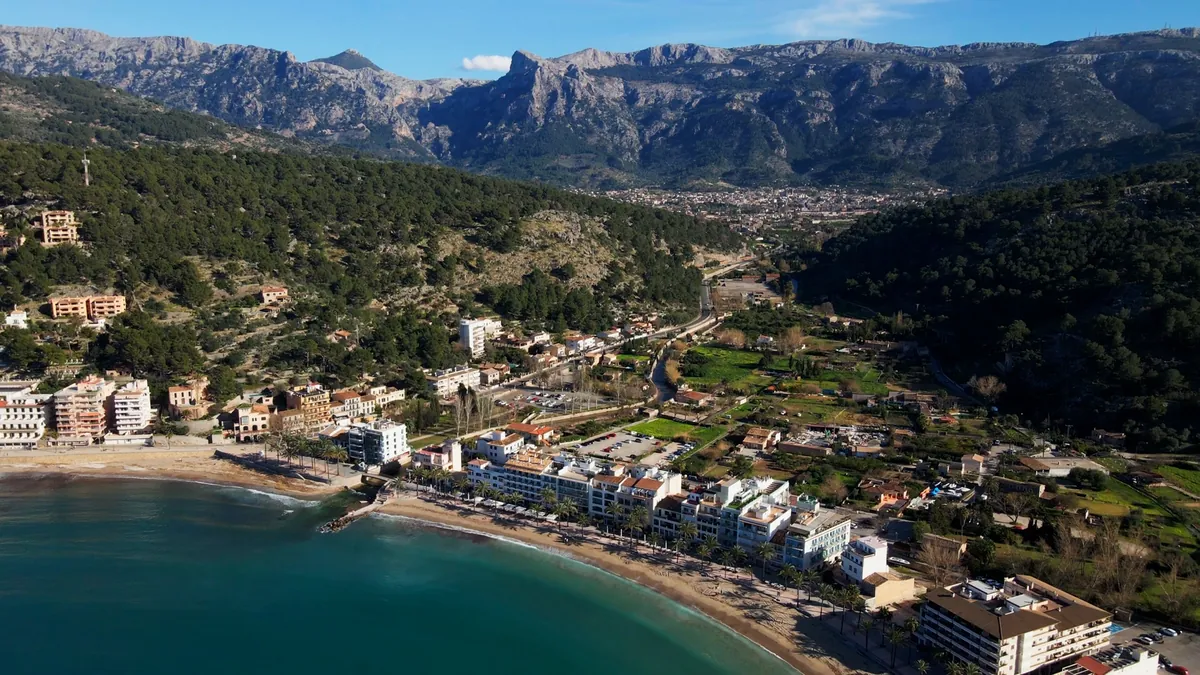
Linger by the almost round bay of Port de Sóller, with fishing boats at anchor and the mountains rising behind. Watch the light change on the water, then ride the tram back up to Sóller for the return to Palma by train or bus. Departures are limited, so check current times before you set out.
Riding the train to Sóller
Sóller lies in a valley on the far side of the , and the railway was built to give the town a direct link with Palma. Opened in 1912, it still runs restored wooden carriages with sash windows and leather seats, some of them dating from the year the line opened. The most celebrated structure on the way is the Cinc Ponts viaduct, whose five arches cross a mountain stream.
The mountains themselves are a protected landscape. In 2011 UNESCO inscribed the Serra de Tramuntana as a cultural landscape, recognising centuries of terraces, dry stone walls and old water channels. Its highest summit, Puig Major, reaches 1,436 metres, the highest point in the Balearic Islands.
When to go
Spring and autumn are the best seasons for walking in the old town and in the mountains, with mild days and a gentler pace than in midsummer. July and August are hot, so start early and save the middle of the day for a museum, a long lunch or a swim. In late January and February the almond trees blossom across the island, covering the fields below the Tramuntana in white and pale pink.
Twice a year, around 2 February and 11 November, the morning sun shines through the great east rose window of La Seu and projects its image onto the wall below the opposite rose window, so that the two form a figure of eight in light. Many people come to see it, so check the cathedral’s dates and times if you would like to be there.
Palma is a capital where a Gothic cathedral stands almost on the shoreline.
Words in this article
- La Seu
- The everyday name for Palma Cathedral, from the Catalan word for the seat of a bishop.
- Pati
- The stone courtyard at the heart of a traditional Palma mansion, often with broad arches and an open staircase.
- Baluard
- Catalan for bastion; Es Baluard is the art museum inside the Renaissance bastion of Sant Pere.
- Tramuntana
- The mountain range along Mallorca’s northwest coast, a UNESCO cultural landscape since 2011, crossed by the Sóller train.
Questions readers ask
Is three days enough for Palma?
Three days are enough for a first visit: one for the cathedral, La Almudaina, the Arab Baths and the patios of the old town, one for Bellver Castle, Es Baluard and the seafront, and one for the train to Sóller and the tram to the port. With a fourth day you could explore Santa Catalina and the coast east of the city at a slower pace.
How do you get from Palma to Sóller?
The historic Sóller train leaves from its station by the Plaça d’Espanya and covers about 27 km through the Serra de Tramuntana, with stops including Bunyola. In Sóller, a historic tram runs about 5 km down to Port de Sóller. Buses also link Palma and Sóller. Timetables change with the seasons, so check current times before you plan your day.
When is the best time to visit Palma?
Spring and autumn are ideal for sightseeing and walking, with mild temperatures and long, bright days. Late January and February bring the almond blossom across the island, while July and August are hot and best enjoyed with early starts. Around 2 February and 11 November, the light of the cathedral’s rose window forms a figure of eight inside La Seu.