
3 days in Zurich: lake, old town and mountain views
Three days in Zurich, from the Grossmünster and Chagall’s windows in the Fraumünster to a swim in the Limmat, the arches of Zurich West and the view from the Uetliberg.
Zurich is a city shaped by water. The Limmat flows out of the lake and straight through the old town, the lake itself stretches south towards the Alps, and on a warm summer afternoon half the city seems to be swimming. Three days give you both banks of the old town, a river bath, the view from the Uetliberg and an afternoon among the paintings of the Kunsthaus.
Two banks, one old town
Zurich’s old town lies on both sides of the Limmat, just where the river leaves the lake. On the right bank, the Niederdorf is a web of lanes, small squares and guild houses rising gently towards the university. On the left bank, quieter streets climb to the Lindenhof and fall away to the Bahnhofstrasse, the long, elegant street that runs from the main station to the lake.
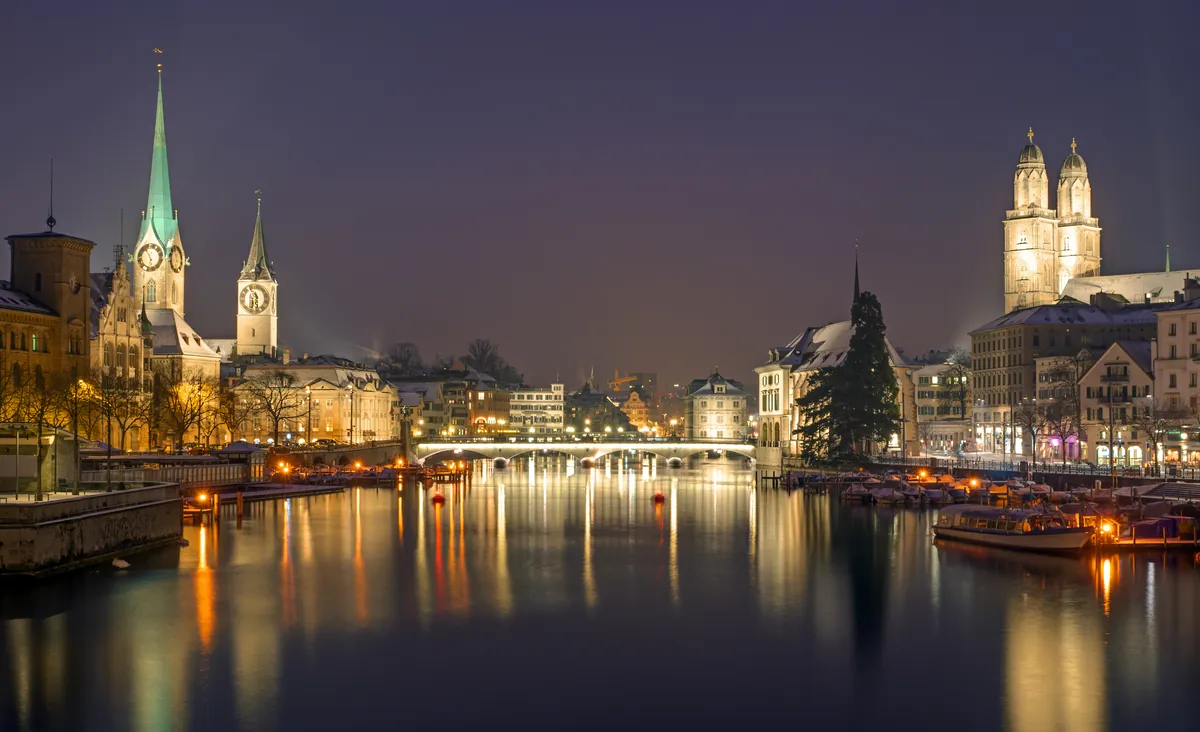
The two great churches face each other across the river. The twin towers of the Grossmünster mark the place where Huldrych Zwingli began preaching in 1519, setting the Reformation in Zurich in motion. Opposite, the slender spire of the Fraumünster rises above the left bank, and inside its choir glow five stained glass windows by Marc Chagall, completed in 1970.
Water is everywhere, and not only in the river. The city counts more than 1,200 fountains, and most carry the same fresh drinking water that comes out of the taps, so a refillable bottle is all you need on a warm day. Many are simple stone basins; others are crowned with carved figures and coats of arms.
Getting there, getting around and where to stay
Trains run from the station beneath the airport to Zürich HB, the main station, in about 10 to 15 minutes, several times an hour. From there, trams fan out across the city, although much of the old town is easiest on foot.
Public transport is organised in the ZVV fare network, and one ticket covers trams, buses, trains and boats within the zones it is valid for. A day pass is the simplest choice for a short stay; on the days you arrive and leave, make sure yours includes the airport zone.
Stay in the old town for short walks to almost everything, in Seefeld for early strolls along the lake, or in Zurich West, the former industrial quarter where warehouses and railway arches have become studios, galleries and places to eat.
Three days, hour by hour
Day one Both banks of the Limmat
- Morning
Grossmünster and the Karlsturm
Begin at the Grossmünster, the twin-towered church where Huldrych Zwingli began preaching in 1519. The interior is plain and calm, in keeping with the Reformation. Then climb the narrow stairs of the Karlsturm, the south tower, for a view over the rooftops, the Limmat and the lake. Renovation work runs until 2029, so check current access.
- Afternoon
Fraumünster and the Lindenhof
Cross the Münsterbrücke to the Fraumünster and sit for a while beneath Marc Chagall’s five choir windows, each glowing in its own dominant colour. Afterwards, wander up through the lanes to the Lindenhof, a terrace shaded by linden trees on the site of a Roman fort, with a view across the river to the Grossmünster.
- Evening
Bahnhofstrasse and the Niederdorf
Stroll the Bahnhofstrasse, which runs for about 1.4 kilometres from the main station to the lake, as the shop windows light up. Then cross back to the Niederdorf for dinner and try Zürcher Geschnetzeltes, thin strips of veal in a creamy mushroom sauce, usually served with golden rösti.
Day two The lake, a river bath and Zurich West
- Morning
Utoquai and Seefeld
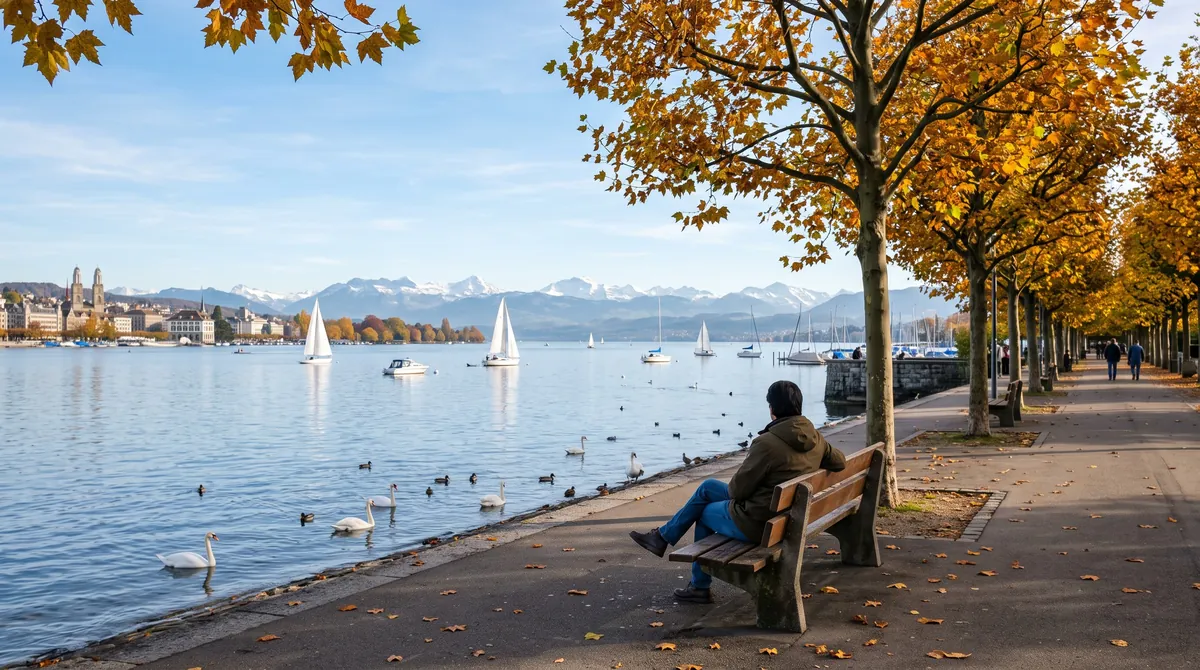
Walk from Bellevue along the Utoquai, the lakeside promenade on the eastern shore, past the wooden lake bath and rows of moored boats. Continue into Seefeld to the Zürichhorn park, where lawns run down to the water and, on clear days, the mountains line the far end of the lake.
- Afternoon
River baths in the city centre
Spend the warm hours at a Badi. The Frauenbadi on the Stadthausquai welcomes women by day, the Männerbad Schanzengraben sits in the old city moat, and the river bath at Oberer Letten lets everyone drift along its swimming channel. Outside the bathing season, swap the swim for a walk along the river.
- Evening
Im Viadukt in Zurich West
Take the tram to Zurich West and walk beneath the arches of the railway viaduct built in 1894, now filled with small shops, studios and a market hall of regional producers, which closes on Sundays. Stay on for dinner in the former industrial streets nearby, where factory halls have found new lives.
Day three Home mountain and art
- Morning
Uetliberg
Take the S10 from Zürich HB for the 20-minute ride up the Uetliberg, Zurich’s Hausberg, or home mountain. A short climb from the station leads to the summit and its lookout tower, with the city and the lake below and, on a clear day, a long line of Alpine peaks beyond.
- Afternoon
Kunsthaus Zürich
Back in town, head to Heimplatz and the Kunsthaus Zürich. Since its extension by David Chipperfield opened in 2021, it has been the largest art museum in Switzerland, with a collection reaching from old masters to contemporary work. A passage beneath the square links the old and new buildings.
- Evening
Bürkliplatz and the lakefront
End where the Bahnhofstrasse meets the water at Bürkliplatz. Walk along the quay as the light fades over the lake and the boats come in. Then cross the Quaibrücke for a last look back at the Grossmünster and the Fraumünster, their towers lit against the evening sky.
Badi culture and a day on the lake
In summer, Zurich swims. A , the local word for a public bath, can be a wooden pavilion on the lake, a stretch of river or a lawn with a diving board, and some of the oldest stand right in the centre. A swim fits easily into a city day here: the water is clear, the baths are close to the sights and the river is never far away.
The Frauenbadi on the Stadthausquai continues a tradition of bathing cabins on this spot that goes back to 1837, and its graceful wooden pavilion dates from 1888. The Männerbad Schanzengraben, opened in 1864, lies in the old moat that once protected the city walls. On some summer evenings both become relaxed bars open to everyone; check current times.
Further downstream, the river bath at Oberer Letten, designed by Elsa and Ernst Burckhardt-Blum and opened in 1952, has a long swimming channel and broad sunbathing terraces. Swimmers let the current carry them along, climb out and walk back to do it all again.
With more time, trade the Kunsthaus for the lake itself. Boats leave Bürkliplatz for Rapperswil, the town of roses towards the eastern end of the lake, a voyage of around two hours depending on the sailing. Its castle stands above an old town and rose gardens that flower from June to October, and the train back to Zürich HB takes about 36 minutes.
Water is everywhere, and not only in the river.
When to go
Summer, roughly June to August, is the season for swimming, long light and evenings by the water. Spring brings the , usually held on the third Monday in April, when the city’s guilds parade in historic costume and the , a snowman figure packed with fireworks, is burnt on the Sechseläutenplatz. Tradition holds that the faster its head explodes, the finer the summer will be.
Autumn brings golden light to the lake shore, and on clear days the Alps stand sharp beyond the water, perfect for the Uetliberg. In winter, the old town glows with Advent lights and Christmas markets, and the museums and warm wood-panelled interiors come into their own.
Words in this article
- Badi
- The Zurich word for a public bath, whether a lake bath, a river bath or an open-air pool.
- Hausberg
- A city’s “home mountain”; in Zurich this is the Uetliberg, reached by the S10 train.
- Zürcher Geschnetzeltes
- Thin strips of veal in a creamy mushroom sauce, a Zurich classic usually served with rösti.
- Sechseläuten
- Zurich’s spring festival, with a guild parade and the burning of the Böögg.
- Böögg
- The snowman figure filled with fireworks that is burnt at the Sechseläuten.
Questions readers ask
How do you get from Zurich airport to the city centre?
Trains leave from the station beneath the airport and reach Zürich HB, the main station, in about 10 to 15 minutes, with several departures an hour. From the main station, trams run to every part of the city, and the old town is within walking distance. A ZVV ticket covering the airport zone is valid for the whole journey.
Can you drink the water from Zurich’s fountains?
Yes. Most of Zurich’s more than 1,200 fountains carry the same fresh drinking water that comes out of the taps, so you can refill a bottle as you walk through the old town or along the lake. If a fountain is not meant for drinking, a small sign says so.
Where can you swim in the centre of Zurich?
Zurich has a long tradition of city baths. The Frauenbadi on the Stadthausquai is for women by day, the Männerbad Schanzengraben lies in the old city moat, and the river bath at Oberer Letten has a long swimming channel on the Limmat. Along the lake, the wooden bath at Utoquai is a lovely place for a morning swim in summer.